Currently Empty: ₹0.00
Discover the finest selection of Nuts, Dry-fruits, Spices, Herbs, Pickles and more…
Welcome to The Village Company.

Currently Empty: ₹0.00
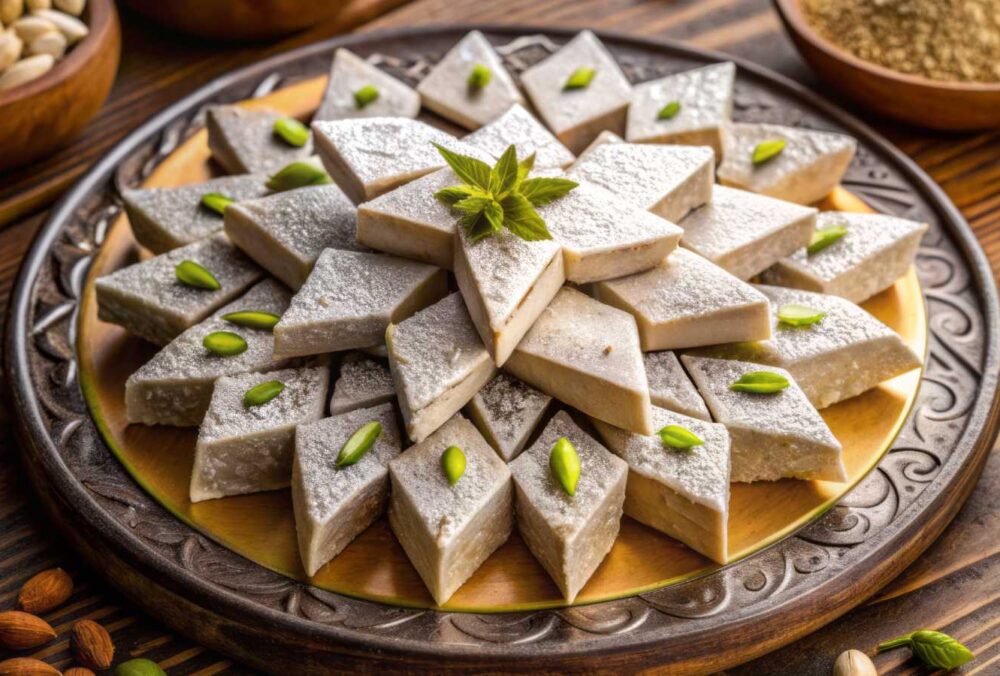
Kaju katli, also known as kaju barfi, is a beloved and classic Indian sweet. It is a rich, delicate, and melt-in-your-mouth delicacy made from cashews, sugar, and water. Kaju katli is a staple for festivals and special occasions in India, and its simplicity and irresistible taste have made it a favorite for all ages.
The traditional kaju katli recipe uses a few simple ingredients:
Cashew nuts (kaju): The primary ingredient, which should be raw, unsalted, and unroasted.
Sugar: White granulated sugar is typically used for a lighter color.
Water: Used to create the sugar syrup.
Ghee (clarified butter): Added for a smoother texture and a richer flavor. It’s also used to grease the working surface and rolling pin.
Cardamom powder or other flavorings: Optional additions for flavor. Rose water or saffron are also popular choices.
Edible silver leaf (vark): An optional garnish that adds a traditional, decorative touch.
Making kaju katli at home involves a few key steps:
Prepare the cashew powder: Grind the cashews into a fine powder. This is a crucial step, and you must use the pulse function of your blender to avoid over-grinding, which can cause the cashews to release their oil and turn into a paste. The powder should be slightly coarse and crumbly, not like a butter.
Make the sugar syrup: In a heavy-bottomed or non-stick pan, combine sugar and water and heat it on a low flame. Stir until the sugar dissolves completely and the mixture comes to a boil. Some traditional recipes call for a specific “one-string consistency,” but for an easier version, you can cook it until the syrup thickens slightly.
Combine the cashew powder: Add the cashew powder to the sugar syrup and mix continuously to avoid lumps. Continue stirring on low heat until the mixture thickens and starts to pull away from the sides of the pan, forming a dough-like consistency. Be careful not to overcook it, as this can make the katli dry and hard.
Knead and roll the dough: Transfer the warm mixture onto a greased surface or parchment paper. Gently knead the dough until it becomes smooth. Place the dough between two sheets of parchment paper and roll it out with a rolling pin to your desired thickness (typically about 1/8 inch).
Garnish and cut: If desired, apply edible silver leaf to the rolled-out dough. Let the dough set for a few minutes before cutting it into the traditional diamond shapes.
Cashew Quality: Use good quality, raw, and dry cashews for the best flavor and texture.
Grinding: Pulse the cashews in short intervals to prevent them from releasing oil. You can also sieve the powder to ensure there are no large lumps.
Cooking: Continuous stirring is essential to prevent the mixture from sticking and burning. Do not overcook the mixture; it should be pliable and not sticky when it’s ready.
Kneading and Rolling: Do this while the dough is still warm. If it cools down too much, it will become hard and difficult to roll. If the dough gets too dry, you can add a few drops of milk to soften it.
काजू कतली के सटीक इतिहास के बारे में कोई पुख्ता जानकारी नहीं है, लेकिन माना जाता है कि इसकी उत्पत्ति भारत के शाही रसोईघरों में हुई थी। एक सिद्धांत यह बताता है कि इसका आविष्कार 16वीं या 17वीं शताब्दी में मुगल साम्राज्य में हुआ था, जहाँ एक शाही रसोइए ने राजघराने के लोगों को खुश करने के लिए यह काजू-आधारित मिठाई बनाई थी। एक और लोकप्रिय कहानी के अनुसार, इसका संबंध मराठा साम्राज्य से है, जहाँ भीमराव नामक एक रसोइए ने कथित तौर पर एक फ़ारसी मिठाई से प्रेरित होकर पारंपरिक बादाम की जगह काजू का उपयोग करके यह मिठाई बनाई थी।
इसकी उत्पत्ति चाहे जो भी हो, काजू कतली मूल रूप से रॉयल्टी और खास मौकों के लिए बनाई जाने वाली एक खास मिठाई थी। समय के साथ, इसकी लोकप्रियता बढ़ती गई, और यह दिवाली, शादियों और अन्य समारोहों के लिए भारत और दुनिया भर में एक पसंदीदा मिठाई बन गई। मिठाई पर लगने वाला पारंपरिक चांदी का वर्क (चांदी का पत्ता) इसकी शाही और उत्सवपूर्ण अपील को और बढ़ाता है।
Discover the finest selection of Nuts, Dry-fruits, Spices, Herbs, Pickles and more…

